
Stem Cells in Oculoplastic Surgery: Emerging Applications in Tissue Engineering
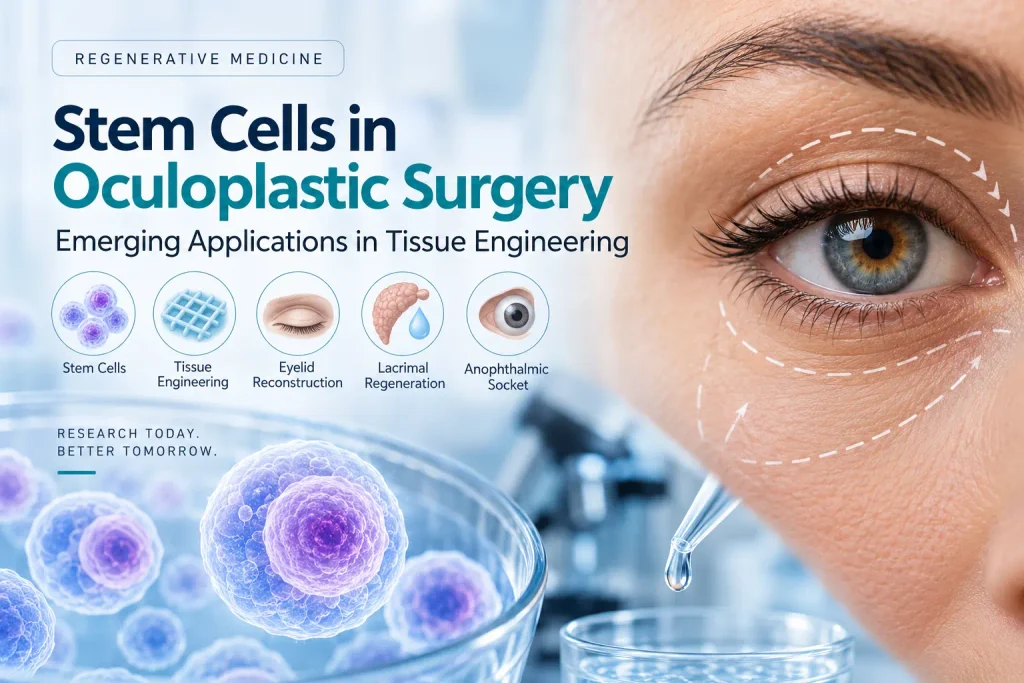
Oculoplastic surgery focuses on the eyelids, orbit, lacrimal system, and other tissues surrounding the eye. These structures are important not only for facial appearance but also for protecting the eye, maintaining the ocular surface, and supporting normal vision-related functions.
Reconstructing damaged or missing periocular tissue can be challenging. Traditional approaches may involve grafts, flaps, implants, or tissue taken from another area of the body. While these techniques remain important in modern oculoplastic surgery, researchers are exploring whether stem cells and tissue engineering could provide additional options for tissue repair and reconstruction.
Advances in regenerative medicine are creating growing interest in the use of mesenchymal stem cells (MSCs), adipose-derived stem cells (ASCs), induced pluripotent stem cells (iPSCs), biomaterials, and tissue-engineered scaffolds.
A 2026 review published in the Indian Journal of Ophthalmology describes the emerging role of stem cells and tissue engineering in oculoplastic surgery, including research involving eyelid reconstruction, periocular volume augmentation, anophthalmic sockets, lacrimal structures, and dynamic eyelid substitutes.
Stem cell research is one part of the broader field of regenerative medicine. To understand the wider applications of this field, you can learn more about stem cell therapy in India, including its potential applications, treatment considerations, and current research.
Quick Answer: What Is the Role of Stem Cells in Oculoplastic Surgery?
Stem cells in oculoplastic surgery are being investigated as a potential approach for supporting tissue repair and developing new reconstructive solutions for the eyelids, orbit, periocular tissues, and lacrimal system.
Researchers are studying mesenchymal stem cells, adipose-derived stem cells, and induced pluripotent stem cells because of their potential to influence tissue repair through cellular differentiation and biological signaling.
Tissue engineering takes this concept further by combining cells with biocompatible scaffolds and biological signals to investigate the development of functional tissue substitutes.
Potential future applications include eyelid reconstruction, periocular tissue regeneration, anophthalmic socket reconstruction, bioengineered lacrimal glands, and dynamic eyelid substitutes.
However, many of these applications remain under research. A clinical trial or laboratory study should not be interpreted as proof that a treatment is already established or effective for routine clinical use.
Table of Contents
What Are Stem Cells?
Stem cells are cells that have the ability to self-renew and, depending on their type and environment, develop into specialized cell populations.
Their potential has made them an important area of research in regenerative medicine.
Scientists are investigating whether stem cells can contribute to tissue repair through several mechanisms, including:
- Differentiation into specialized cells
- Cell-to-cell communication
- Paracrine signaling
- Release of growth factors and other biological molecules
- Modulation of inflammatory responses
- Interaction with surrounding tissues
The effects of stem cells can vary according to the type of cell, its source, preparation method, delivery technique, and the tissue being treated.
Types of Stem Cells Being Studied
Several stem-cell populations are being investigated in regenerative medicine and ophthalmology.
Mesenchymal Stem Cells (MSCs)
Mesenchymal stem cells (MSCs) are among the most widely studied cell populations in regenerative medicine.
Researchers are interested in their potential ability to interact with surrounding tissues and release signaling molecules that may influence inflammation, wound healing, and tissue responses.
Their possible applications in oculoplastic reconstruction remain an area of ongoing research.
Adipose-Derived Stem Cells (ASCs)
Adipose-derived stem cells (ASCs) are obtained from adipose tissue and have attracted interest in soft-tissue and regenerative research.
Researchers are studying their potential role in tissue repair, wound healing, and periocular soft-tissue applications.
Induced Pluripotent Stem Cells (iPSCs)
Induced pluripotent stem cells (iPSCs) are mature cells that have been reprogrammed into a pluripotent state.
Because they can potentially be directed toward different specialized cell types, iPSCs are an important tool for regenerative medicine research and disease modelling.
Their potential applications in ophthalmology include research into specialized ocular tissues and patient-specific cellular models.
How Could Stem Cells Support Tissue Repair?
One of the reasons stem cells are being studied is their potential to influence the environment around damaged tissue.
Their effects may involve both direct and indirect mechanisms.
For example, stem cells may interact with nearby cells and release biological signals that influence processes involved in healing and tissue maintenance.
This paracrine effect is an important area of regenerative medicine research.
However, the biological response is complex and depends on the specific cell population, treatment method, tissue environment, and medical condition.
What Is Tissue Engineering?
Tissue engineering is an area of regenerative medicine that combines cells, biomaterials, and biological signals to investigate ways of repairing or developing biological tissues.
A simplified tissue-engineering model can be described as:
Cells + Biocompatible Scaffold + Biological Signals → Tissue Development or Repair
Cells
Cells provide the biological component of the engineered tissue.
Scaffolds
A biocompatible scaffold can provide structural support and an environment in which cells may attach, grow, and organize.
Growth Factors and Biological Signals
Growth factors and other signaling molecules can influence cellular activity, growth, and tissue development.
Researchers are investigating how these components can be combined to develop tissue substitutes that may eventually have both structural and functional properties.
Stem Cells and Eyelid Reconstruction
The eyelid is a complex structure consisting of multiple tissue layers and specialized components.
These include:
- Skin
- Muscle
- Tarsal tissue
- Conjunctiva
- Supporting connective tissues
Reconstructing an eyelid therefore involves more than replacing missing skin. The reconstructed tissue may also need to support appropriate eyelid movement, ocular protection, and interaction with the ocular surface.
Researchers are investigating whether tissue engineering could eventually contribute to the development of substitutes for structures such as eyelid skin, tarsus, and conjunctiva.
These approaches are promising areas of research but should not currently be considered replacements for established reconstructive procedures in every patient.
Periocular Tissue Regeneration and Volume Augmentation
Changes in the tissues around the eye can occur because of ageing, trauma, previous surgery, disease, or tissue loss.
Periocular volume augmentation and tissue regeneration are therefore additional areas of interest in regenerative medicine.
Adipose-derived cells and other cell-based approaches are being investigated for their potential role in soft-tissue repair and volume restoration.
The potential advantage of regenerative approaches is that they may eventually provide biological solutions rather than relying exclusively on conventional grafting or synthetic materials.
However, more research is needed to determine the appropriate techniques, long-term outcomes, and safety of these approaches.
Stem Cells and Anophthalmic Socket Reconstruction
An anophthalmic socket is the orbital space remaining after the loss or surgical removal of an eye.
Reconstruction generally aims to restore appropriate orbital volume and create a suitable environment for an ocular prosthesis.
Traditional approaches may involve orbital implants, grafts, flaps, and other reconstructive procedures.
Researchers are exploring whether stem cells and tissue-engineering techniques could eventually contribute to soft-tissue restoration and improve the biological environment of an anophthalmic socket.
The 2026 Indian Journal of Ophthalmology review identifies anophthalmic socket management as one of the potential areas of application for regenerative approaches in oculoplastic surgery.
Could Stem Cells Help With Lacrimal Gland Regeneration?
The lacrimal glands play an important role in producing tears and maintaining the ocular surface.
Damage or dysfunction of the lacrimal system can affect tear production and ocular comfort.
One emerging research area is the development of bioengineered lacrimal glands.
Researchers are investigating whether stem cells, scaffolds, and biological signals could eventually be used to develop lacrimal tissue with appropriate structural and functional characteristics.
Creating a functional lacrimal gland is challenging because engineered tissue would need to reproduce important biological functions rather than simply resemble the natural gland.
For this reason, bioengineered lacrimal tissue remains an area of ongoing research.
Dynamic Eyelid Substitutes: A Future Possibility
The eyelid is a dynamic structure that repeatedly opens and closes.
It protects the eye, helps distribute the tear film, and contributes to normal ocular surface function.
Because of this, creating a functional dynamic eyelid substitute is considerably more complicated than developing a simple structural replacement.
Researchers are investigating whether tissue engineering and biomaterials could eventually contribute to eyelid substitutes that better reproduce the structural and mechanical characteristics of natural eyelid tissue.
This remains a future-oriented area of research.
Could Tissue Engineering Reduce Donor-Site Morbidity?
Traditional reconstructive surgery may require tissue to be harvested from another part of the patient’s body.
Although grafts and flaps are important reconstructive options, harvesting tissue can create an additional surgical site and associated healing considerations.
One potential benefit of tissue engineering is the possibility of developing suitable tissue substitutes that could reduce reliance on certain donor tissues.
If these approaches can eventually demonstrate appropriate safety, durability, and function, they may help address some limitations associated with traditional reconstruction.
At present, however, this remains an area requiring further clinical investigation.
Clinical Trials and Research
Stem cell and tissue-engineering research takes place across several stages.
These may include:
- Laboratory research
- Preclinical studies
- Early human studies
- Clinical trials
- Larger clinical investigations
- Potential integration into routine clinical practice
Each stage provides different information.
A laboratory result does not automatically mean that a treatment will work in humans. Similarly, the presence of a treatment in a clinical trial database does not mean that its effectiveness has already been established.
Patients should therefore evaluate clinical evidence specific to the condition, cell type, treatment method, and study design.
ClinicalTrials.gov provides a searchable database of registered clinical studies and can be used to verify information about individual trials.
Important Considerations Before Stem Cell Treatment
Interest in regenerative medicine is increasing, but patients should carefully evaluate any proposed stem-cell-based treatment.
Before considering treatment, it can be useful to ask:
- What condition is being treated?
- What type of stem cells are being used?
- Where do the cells come from?
- How are the cells prepared?
- Is the treatment established or investigational?
- Is it part of a registered clinical trial?
- What human clinical evidence supports the treatment?
- What are the potential risks?
- What alternatives are available?
- How will treatment outcomes be monitored?
These questions can help patients understand whether a proposed treatment is supported by appropriate evidence.
Potential Risks and Limitations
Stem cell and tissue-engineering treatments can involve risks, and the potential risks vary depending on the cells, biomaterials, delivery method, and medical condition.
Potential concerns may include:
- Infection
- Inflammation
- Immune reactions
- Unexpected tissue growth
- Problems related to implanted materials
- Treatment failure
- Limited long-term safety information
Another important limitation is that regenerative medicine is a rapidly developing field. Evidence may be strong for one application but limited for another.
Therefore, patients should avoid assuming that a stem cell treatment that is being investigated for one condition will have the same safety or effectiveness for another condition.
Stem Cell Research vs. Proven Treatment
Understanding the difference between research and established treatment is particularly important.
A potential therapy may move through several stages:
Laboratory research → Preclinical research → Clinical trial → Evidence evaluation → Established treatment
Not every therapy reaches the final stage.
Clinical trials are designed to determine whether an intervention is safe and effective. They are not themselves proof that the treatment works.
Patients should therefore discuss the evidence and treatment status with an appropriately qualified healthcare professional.
The Future of Stem Cells and Tissue Engineering in Oculoplastic Surgery
The future of regenerative oculoplastic surgery may involve a combination of technologies rather than stem cells alone.
Researchers are exploring areas such as:
- Stem-cell-based therapies
- Tissue-engineered scaffolds
- Biomaterials
- Growth-factor delivery
- iPSC technology
- Cell-derived products
- Bioengineered lacrimal tissue
- Dynamic eyelid substitutes
- Periocular tissue regeneration
The long-term goal is to develop approaches that can restore not only the appearance of damaged tissue but also its biological and functional properties.
As research advances, tissue engineering may offer new possibilities for reconstructive surgery, although substantial work remains before many experimental concepts can become routine clinical treatments.
Frequently Asked Questions
What is the role of stem cells in oculoplastic surgery?
Stem cells are being investigated for their potential role in tissue repair, wound healing, and reconstruction of tissues around the eye, including the eyelids, orbit, and periocular structures.
Which stem cells are studied in oculoplastic surgery?
Research includes mesenchymal stem cells (MSCs), adipose-derived stem cells (ASCs), and induced pluripotent stem cells (iPSCs), among other cell populations.
Can stem cells be used for eyelid reconstruction?
Stem cells and tissue engineering are being investigated for eyelid reconstruction, including potential development of tissue substitutes for structures such as skin, tarsus, and conjunctiva. Many of these applications remain under research.
What is tissue engineering in ophthalmology?
Tissue engineering combines cells, biocompatible materials or scaffolds, and biological signals to investigate ways of developing or repairing functional ocular tissues.
Can stem cells help with anophthalmic socket reconstruction?
Anophthalmic socket reconstruction is one of the areas being explored in regenerative oculoplastic research. However, the clinical role of these approaches continues to develop.
Can researchers bioengineer a lacrimal gland?
Bioengineered lacrimal glands are an emerging research area. Scientists are investigating how cells, scaffolds, and biological signals could potentially be combined to create functional lacrimal tissue.
Are stem cell treatments for eye conditions proven?
The evidence varies significantly depending on the condition and treatment. Some cell-based therapies have established clinical applications, while many newer ophthalmic and oculoplastic applications remain investigational.
Does a clinical trial mean a stem cell treatment is proven?
No. A clinical trial is designed to evaluate safety and effectiveness. Participation in or registration of a clinical trial does not by itself establish that a treatment is effective.
Conclusion
Stem cells and tissue engineering in oculoplastic surgery represent an evolving area of regenerative medicine.
Research is exploring potential applications ranging from eyelid reconstruction and periocular tissue regeneration to anophthalmic socket management, lacrimal gland regeneration, and dynamic eyelid substitutes.
The combination of stem-cell biology, biomaterials, tissue engineering, and reconstructive surgery may eventually provide new approaches to repairing or replacing damaged tissues around the eye.
However, many of these applications remain under investigation. More clinical research is needed to establish their safety, effectiveness, durability, and long-term outcomes.
For patients considering stem cell or regenerative treatment, it is important to understand the specific therapy being proposed, the quality of available evidence, potential risks, treatment alternatives, and whether the approach is established or investigational.
References
- Saini M, Gaba S, Singh U, Saini K, Gupta PC, Singh M, Sidhu T, Gupta P. Emerging role of stem cells and tissue engineering in oculoplastic surgery. Indian Journal of Ophthalmology. 2026;74(9):1285. doi:10.4103/IJO.IJO_3200_25.
- ClinicalTrials.gov. U.S. National Library of Medicine. Database of registered clinical studies.
Medical Disclaimer: This article is intended for general educational purposes only and should not be considered medical advice. Stem-cell and tissue-engineering approaches can differ substantially in their evidence, indications, potential risks, and regulatory status. Patients should consult an appropriately qualified healthcare professional before making treatment decisions.