
Stem Cell Therapy for Autism: Where Does the Research Stand Today?
Parents looking into stem cell therapy for autism often come across very different opinions online.
Some websites describe stem cells as a promising new option. Others say there is not enough evidence to support their use. So, what does the research actually tell us?
The answer is that research is ongoing.
Scientists are studying different cell-based approaches to understand whether they could influence biological processes associated with autism spectrum disorder (ASD). Much of the recent research has focused on mesenchymal stromal/stem cells (MSCs), along with umbilical cord-derived cells and cord blood.
Some early studies have reported encouraging findings. However, other controlled studies have not demonstrated significant improvements in their main outcomes.
This is why it is important to look at the actual research rather than relying on headlines, testimonials or treatment claims.
A 2026 review of MSC-based therapies for autism described the field as an emerging area of research while highlighting important challenges such as small study populations, differences between treatment protocols and limited long-term evidence. while highlighting important challenges such as small study populations, differences between treatment protocols, open-label study designs and limited long-term evidence.
Table of Contents
Why Are Scientists Studying Stem Cells for Autism?
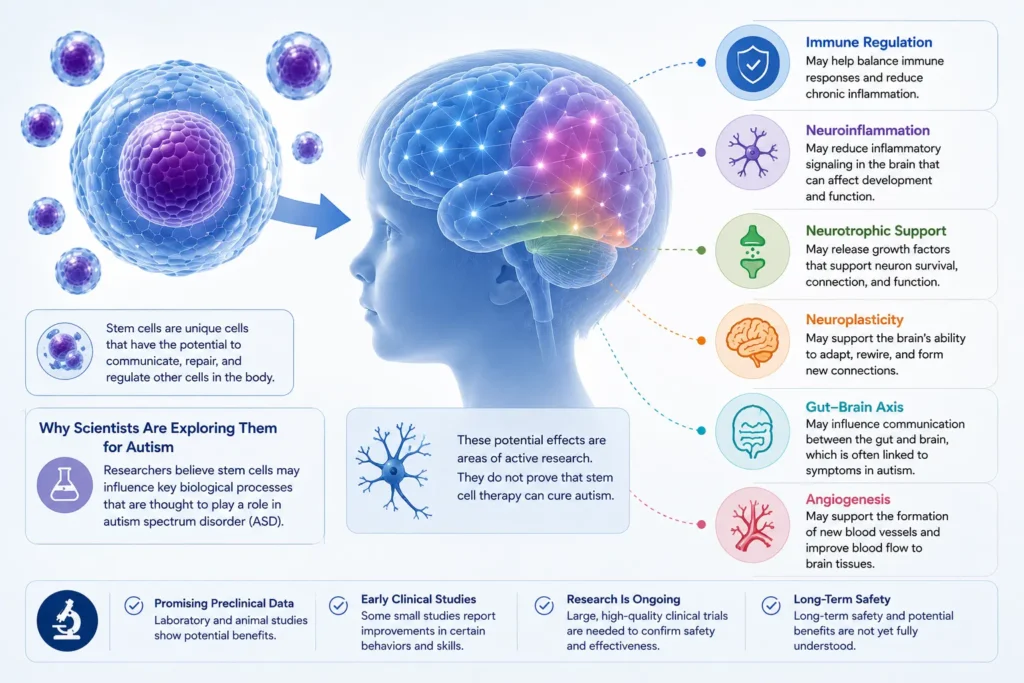
Autism is a complex neurodevelopmental condition. Researchers are investigating a number of biological processes that may be associated with ASD.
These include immune signaling, neuroinflammation, cellular communication and processes involved in brain development and function.
MSCs have attracted attention because they can interact with surrounding cells and release signaling molecules that may influence biological processes.
Researchers are studying whether these properties could potentially affect:
- Immune regulation
- Neuroinflammatory signaling
- Neurotrophic signaling
- Cellular communication
- Neuroplasticity
- Blood-vessel formation
- Gut-brain signaling
A recent 2026 review discusses several of these potential mechanisms, including inflammatory signaling, neurotrophic factors, synaptic plasticity and the gut-brain axis.
It is important to make one distinction clear: a possible biological mechanism does not prove that a treatment is clinically effective.
What Types of Stem Cells Are Being Studied for Autism?
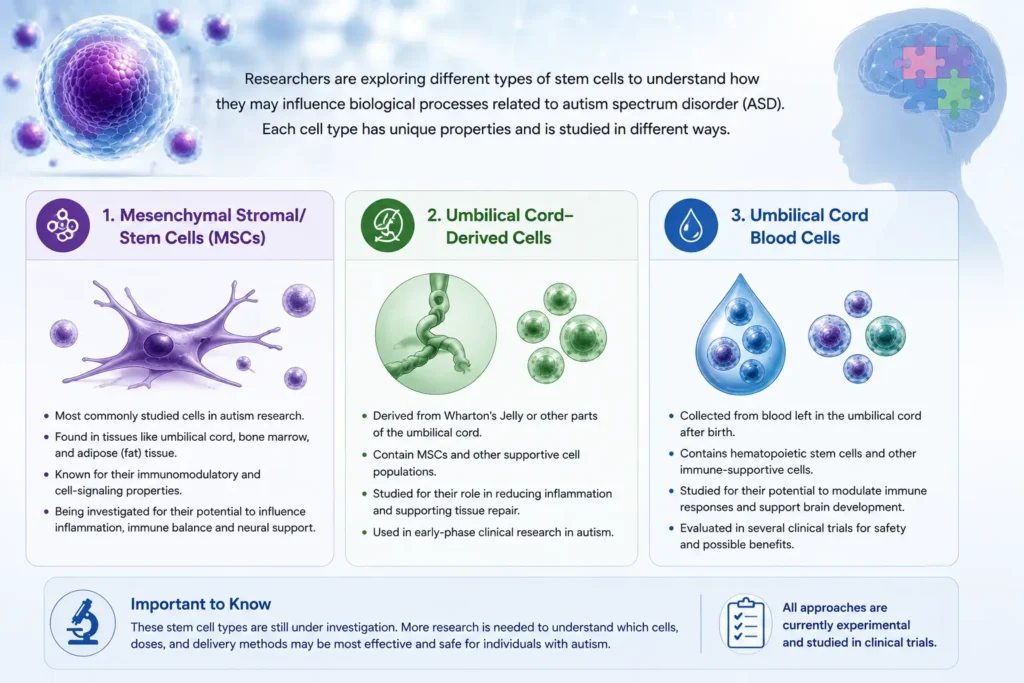
When people talk about “stem cell therapy,” they may actually be referring to several different research approaches.
Mesenchymal Stromal/Stem Cells
Mesenchymal stromal/stem cells, usually called MSCs, are among the main cell types being studied.
Researchers are interested in their potential immunomodulatory and cell-signaling properties.
MSCs have been investigated from different sources, including umbilical cord tissue and bone marrow.
Umbilical Cord-Derived Cells
Another area of research involves cells obtained from umbilical cord tissue.
Researchers have investigated whether these cells may influence biological processes relevant to ASD.
However, studies involving different cell sources should not automatically be treated as equivalent. The cell type, preparation, dose and administration method can all be different.
Umbilical Cord Blood
Cord blood has also been studied in children with autism.
One randomized, placebo-controlled, double-blind Phase II study involved 180 children with ASD and compared autologous cord blood, allogeneic cord blood and placebo.
The researchers reported that the treatment was safe and well tolerated, but the overall study did not demonstrate improvement in the primary social-communication outcome.
This is an important reminder that encouraging early research needs to be confirmed through well-designed clinical trials.
What Have Clinical Studies Found So Far?
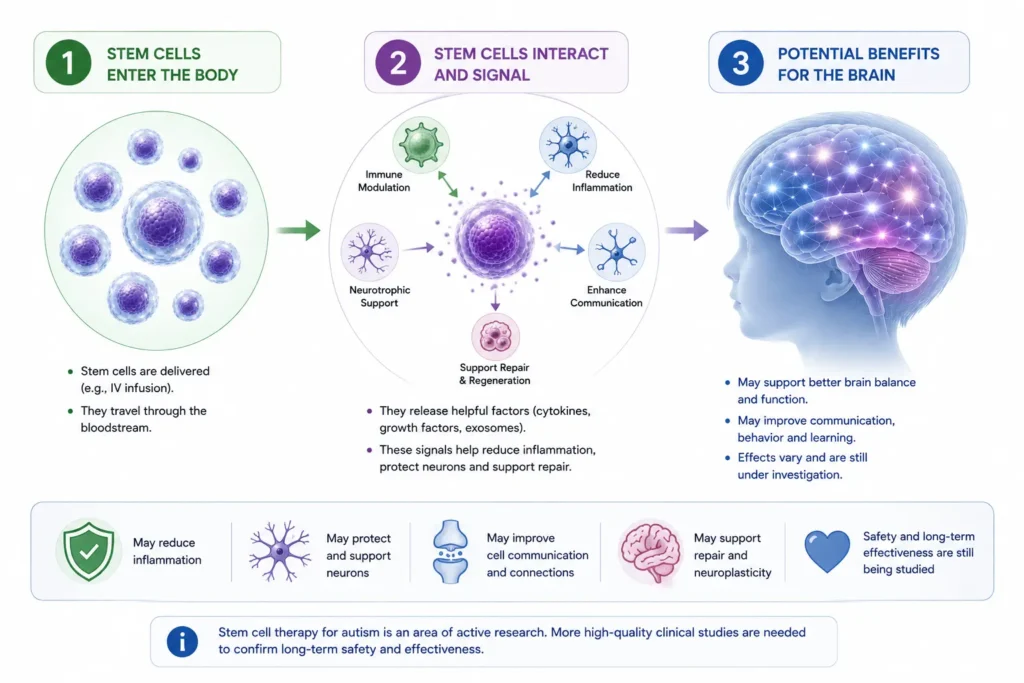
The results from clinical research are mixed.
Some early studies have reported improvements in selected behavioral or developmental measurements. However, many of these studies were small or had methodological limitations.
For example, the ICMR evidence assessment reviewed several studies involving stem cell approaches for ASD and identified limitations such as small sample sizes, non-randomized designs, open-label studies and inadequate long-term follow-up.
This doesn’t mean that the research is unimportant.
It means that researchers need better-designed studies before firm conclusions can be made.
What Did the Larger Randomized Cord Blood Study Find?
One of the more informative studies investigated cord blood in 180 children with ASD.
The trial used a randomized, placebo-controlled and double-blind design.
Children received either:
- Autologous cord blood
- Allogeneic cord blood
- Placebo
The researchers evaluated outcomes after treatment and found that cord blood infusion was safe and well tolerated.
However, the overall study did not show a significant improvement in its primary social-communication outcome.
This kind of result is valuable because it helps researchers understand where the evidence is strong and where more research is needed.
What Does the Latest 2026 Research Tell Us?
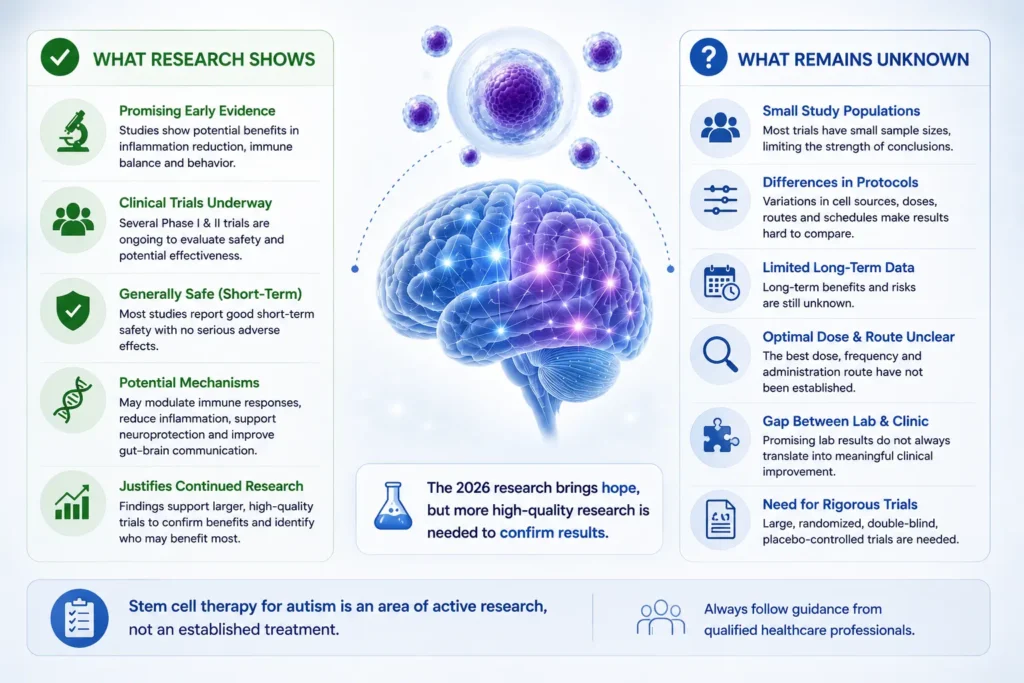
A 2026 review published in the Journal of Translational Medicine examined recent evidence surrounding MSC-based therapies for autism.
The researchers reviewed preclinical studies as well as registered early-phase clinical trials.
The review identified nine registered Phase I and Phase II clinical trials as of March 2026.
The research provides reasons for continued investigation, particularly around potential biological mechanisms and early findings.
At the same time, the review highlights several challenges:
- Small clinical trial populations
- Different cell sources
- Differences in treatment protocols
- Uncertainty around optimal dosing
- Open-label study designs
- Limited long-term follow-up
- The gap between laboratory findings and established clinical treatment
The researchers therefore emphasize the need for stronger evidence on long-term effectiveness and safety.
Why Can’t We Say Stem Cell Therapy Cures Autism?
This is one of the most important points for families to understand.
Current research does not establish stem cell therapy as a cure for autism.
Autism is highly variable. Children can have very different communication abilities, developmental profiles, behaviors and support needs.
Clinical studies also differ in many ways.
Researchers may use different:
- Cell types
- Cell sources
- Doses
- Administration routes
- Treatment schedules
- Outcome measurements
Because of these differences, one study cannot automatically be used to predict what will happen to another child.
What Are Researchers Still Trying to Understand?
There are several major questions that remain unanswered.
Which children might benefit?
Researchers need to understand whether certain biological or clinical characteristics could identify people who may respond differently.
Which cells are most appropriate?
MSCs, cord blood and other cell populations are not identical.
More research is needed to understand whether particular cell types are better suited to specific research questions.
What dose should be used?
Different studies may use different doses.
Researchers need evidence-based dosing rather than assuming that a higher dose will necessarily produce a better result.
What is the best administration route?
Studies have explored different routes of administration.
The appropriate route depends on the specific treatment and research protocol.
How long could potential effects last?
A change seen several months after treatment does not tell us whether that change will remain for years.
Long-term follow-up is therefore important.
What are the long-term safety considerations?
Researchers need to continue monitoring participants to understand potential risks over longer periods.
Are Clinical Trials Still Being Conducted?
Yes.
Clinical research into cell-based approaches for autism is continuing.
The 2026 review identified nine registered early-phase Phase I and Phase II MSC-related clinical trials as of March 2026.
But there is an important distinction between being studied and being established.
A clinical trial is designed to answer questions such as:
- Is the treatment safe?
- What dose should be investigated?
- Which administration method is appropriate?
- Are there measurable benefits?
- Which patients might respond?
- What side effects occur?
- Can the findings be reproduced?
Therefore, the existence of a clinical trial should not be interpreted as proof that a treatment has already been established.
Families and researchers can also review registered clinical trials for autism to understand which cell-based approaches are currently being investigated.
What Does ICMR Say About Stem Cell Therapy for Autism?
For families in India, this is particularly important.
The Indian Council of Medical Research (ICMR) has published an evidence-based assessment specifically addressing stem cell therapy for autism spectrum disorder.
ICMR reviewed the available scientific evidence and reported important limitations in the existing studies.
Its 2021 recommendation states that stem cell therapy should not be offered as a standard or routine therapy for autism and that therapeutic use should be restricted to appropriately approved clinical trials with the necessary regulatory approvals.
This should be considered by anyone researching stem cell therapy for autism in India.
What Should Parents Look for When Reading Stem Cell Research?
A scientific paper can look impressive at first glance, but there are several questions worth asking.
How many people participated?
A study involving a small number of participants provides different evidence from a large randomized trial.
Was there a control group?
A control group helps researchers determine whether changes may be related to the treatment.
Was the study randomized?
Randomization helps reduce certain forms of bias.
Was it blinded?
Blinding can help reduce the influence of expectations on study outcomes.
What type of cells were used?
Look for the exact cell type and source.
What dose was used?
Different studies may use different amounts.
How were the cells administered?
The administration route can be an important part of the research protocol.
What outcome was measured?
A study may measure communication, socialization, behavior or another specific outcome.
How long were participants followed?
Longer follow-up can provide more information about durability and safety.
Is There a Proven Stem Cell Therapy Success Rate for Autism?
There is currently no universal success rate that can reliably predict how an individual child with autism will respond to stem cell therapy.
Different studies use different:
- Participants
- Cell types
- Doses
- Protocols
- Outcome measures
- Follow-up periods
For that reason, parents should be cautious about websites or clinics advertising a specific percentage as a guaranteed or universal success rate.
A more useful question is:
Where did that percentage come from, and was it demonstrated in a well-designed, peer-reviewed clinical study?
Stem Cell Research vs Established Autism Support
Another important distinction is between investigational research and established autism support.
Stem Cell Research
Researchers are investigating whether specific cell-based approaches are safe and effective.
Established Autism Support
Established approaches can address individual needs related to communication, learning, behavior, daily living and development.
Commercial Availability
A treatment being available commercially does not automatically mean that it has been scientifically established for autism.
Families should therefore look at the evidence behind the specific treatment being offered, rather than relying only on its availability or marketing claims.
Should Stem Cell Therapy Replace Existing Autism Support?
Current evidence does not support replacing established autism support with stem cell therapy.
Autism support is individualized. Depending on the person’s needs, it may include:
- Speech and language therapy
- Occupational therapy
- Behavioral interventions
- Educational support
- Communication support
- Support for associated conditions
Parents should speak with qualified healthcare professionals before making significant changes to an existing treatment or support plan.
What Could Future Autism Stem Cell Research Focus On?
Future research will need to answer more specific questions.
Researchers are likely to focus on:
- Identifying patients who may respond
- Standardizing cell preparations
- Determining appropriate doses
- Understanding administration routes
- Improving clinical trial design
- Measuring meaningful outcomes
- Monitoring long-term safety
- Reproducing findings across independent studies
The 2026 review specifically highlights standardization, dose optimization and the need for stronger evidence of long-term effectiveness and safety.
What Should Parents Take Away From Current Research?
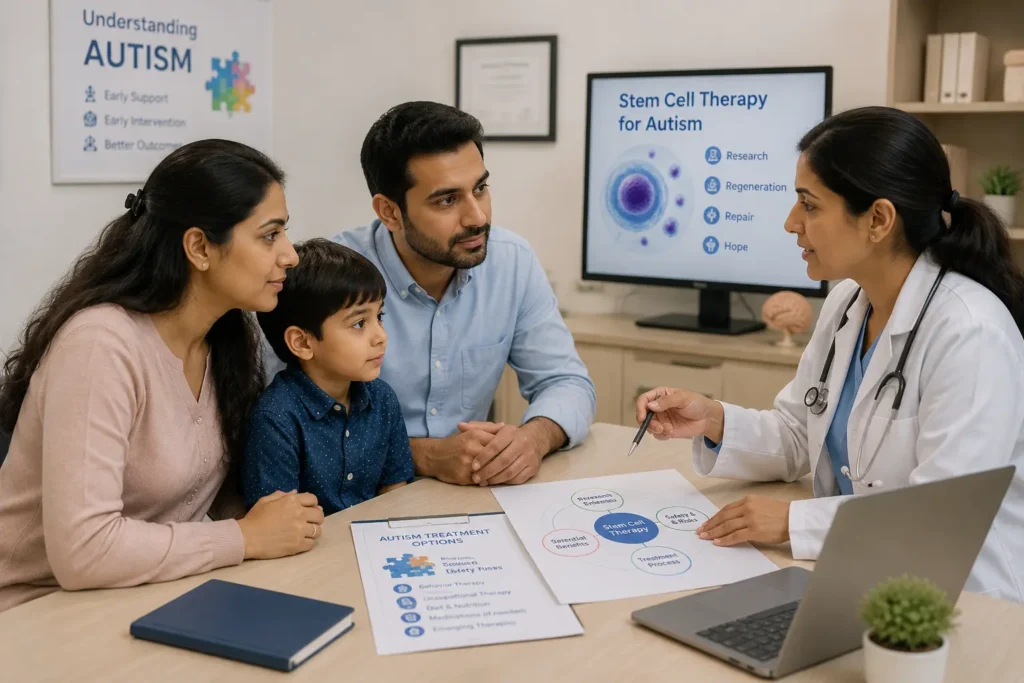
The current research is neither a simple “yes” nor a simple “no.”
There are scientific reasons for continuing to study cell-based approaches for autism. Early research has produced findings that justify further investigation.
At the same time, the available evidence has important limitations, and some controlled studies have not demonstrated significant improvements in their primary outcomes.
The most accurate way to describe the current situation is:
Stem cell therapy for autism remains an area of clinical research and is not established as a cure for autism.
For parents, the most useful question is not simply:
“Does stem cell therapy work?”
A better question is:
“What evidence exists for this specific treatment, how strong is that evidence, and what are the known risks?”
That approach can help families make more informed decisions with qualified healthcare professionals.
Frequently Asked Questions
Is stem cell therapy for autism scientifically proven?
No. Current evidence does not establish stem cell therapy as a routine treatment for autism. ICMR’s evidence assessment does not support it as standard therapy.
What types of stem cells are studied for autism?
Research has investigated mesenchymal stromal/stem cells, umbilical cord-derived cells, cord blood and other cell populations.
What does the latest research say about stem cell therapy for autism?
A 2026 review describes growing preclinical and early clinical research into MSC-based approaches but also highlights small studies, differences in protocols and limited long-term evidence.
Can stem cells cure autism?
Current scientific evidence does not establish stem cell therapy as a cure for autism.
Is stem cell therapy an established autism treatment in India?
ICMR does not recommend stem cell therapy as routine treatment for autism. Its evidence assessment recommends that therapeutic use be restricted to appropriately approved clinical trials.
Are researchers still conducting clinical trials?
Yes. Researchers continue to investigate different cell-based approaches for ASD, including MSC-based therapies.
What is the success rate of stem cell therapy for autism?
There is no scientifically established universal success rate that can predict how an individual child will respond.
Is stem cell therapy safe?
Safety depends on the specific cell type, preparation, dose, administration method and research protocol. Some studies have reported acceptable short-term safety, but longer-term safety requires further investigation.
Should parents stop existing autism therapies before considering stem cell therapy?
Parents should not change an existing treatment or support plan based solely on online information. Any change should be discussed with the child’s qualified healthcare professionals.
Final Thoughts
Stem cell therapy is an evolving area of autism research.
Scientists are investigating whether specific cell-based approaches could influence biological processes associated with ASD. The findings so far are interesting enough to justify continued research, but they do not yet establish stem cell therapy as a proven cure.
For families, the most important distinction is between research and established treatment.
A promising laboratory result is only the beginning. Clinical trials, larger studies, independent replication and long-term follow-up are needed before researchers can determine whether a particular approach provides meaningful and lasting benefits.
For parents in India, it is especially important to understand the current scientific and regulatory position before considering an investigational treatment.
The goal should be evidence, transparency, safety and informed decision-making.
Medical Disclaimer
This article is intended for educational and informational purposes only. It is not a substitute for individualized medical advice, diagnosis or treatment. Stem cell therapy for autism remains an area of research. Families should consult qualified healthcare professionals before considering any medical intervention.